
Search
  • You have no bookmark.

Your Wishlist : 0 listings

Sign In

Category: Education & Academic

Concerns and Opportunities with AI in Education

Over the last two decades, the landscape of teaching has undergone a profound transformation. Once a profession filled with creativity and freedom, teaching today often feels burdened by a mountain of paperwork, rigid curriculum standards, and the constant pressure to track data.

Now, with the rapid rise of artificial intelligence (AI), a new wave of uncertainty is rippling through the educational world. Understandably, many educators are asking themselves: What will AI mean for my classroom?
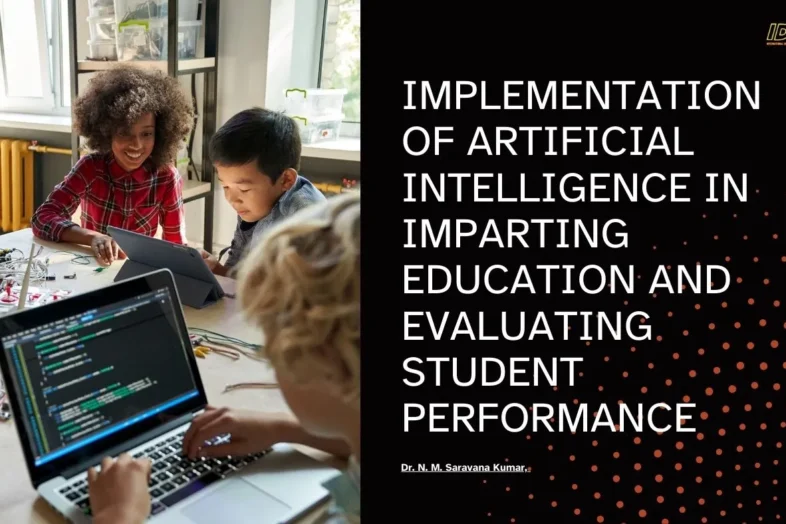

Implementation of Artificial Intelligence in Imparting Education and Evaluating Student Performance

Implementation of Artificial Intelligence in Imparting Education and Evaluating Student Performance

Dr. N. M. Saravana Kumar,Professor,Department of Computer Science and Engineering,Vivekananda Engineering College,Namakkal, India.saravanakumaar2008@gmail.com Abstract: Simulation of human intelligence process is made possible with the help of artificial intelligence. The learning, reasoning and self-correction properties are made possible in computer systems. Along with AI, other technologies are combined effectively in order to create remarkable applications. We apply the changing role of AI and its techniques in new educational paradigms to create a personalised teaching-learning environment. Features like recognition, pattern matching, decision making, reasoning, problem solving and so on are applied along with knowledge based system and supervised machine learning for a complete learning and assessment process. Keywords: Artificial Intelligence, Artificial Neural Network, Capsule Network, Educational Technology, Electronic Learning 1.     INTRODUCTION Artificial Intelligence is making its place in our day-to-day life at a rapid phase. Researchers and scientists are building innovative approaches in computer modelling, machine learning, probability statistics and decision theory to develop more effective diagnostic methods. AI can perform simple tasks like making a coffee in the morning to complex chores like vacuuming the floor without the need to even touch the vacuum cleaner [2]. There is also a prospective disadvantage of AI becoming too clever. For over 30 years, research is conducted in implementing artificial intelligence in the field of education. Adaptive learning environment and other tools that are flexible, personalised, effective, inclusive and engaging are being developed and promoted. AI can be defined as a modelling science that is used in investigating, developing and applying formalised models that has salient aspects relevant to learning and instruction. It allows reasoning and derivation of novel facts, which gives a dynamic flavour to the models in use [1]. The adaptive learning environment adapts teaching learning approaches and materials based on the capabilities and requirements of the individual learners. In this paper, we propose an artificial intelligence platform that can be used in imparting education as well as evaluating the student performance. It can be modified to adjust to the need of any level of education. The major AI schemes like recognition and pattern matching, decision making and choice, conceptual interface and reasoning, execution and sequential control as well as planning and problem solving are used in the development of the AI platform. For evaluation of student performance, knowledge based systems and supervised machine learning techniques are used. 2.     EXISTING LITERATURE The roles and applicability of AI techniques has been continuously changing. The education community is finding innovative ways to productively implement AI for faculty and learners. AI should be leveraged to create an improved student experience. Elon University used AI in order to help students in tracking previously taken courses and help them apply this information in course-planning (Lee Gardner, 2018). AI is used in Free Application for Federal Student Aid (FAFSA) completion, campus tour and class scheduling. Georgia State University uses a chatbot called Pounce, built by AdmitHub that reaches out students through text to intimate incomplete tasks by set dates (Page & Gehlbacj, 2018). AI sends reminders to students about important dates. It also provides information to the students such as required classes for program completion and offer of those classes. It allows the faculty to upload notes of the classes online that can be accessed by the students [3]. AI has the ability to recognize an instance of categories, concepts or patterns. AI can draw on inference, planning and execution; monitor development of ideas as they are executed; identify environmental irregularities and modify their plans in return [4]. AI is being used in smart toys and computationally organized scholastic and entertainment materials. Williams et al. [5] uses a programmable, social robot that can guide children’s exploration of AI concepts. It helps in a positive understanding of the AI concepts such as planning, reasoning, perception and deep learning. A lecture robot system [6], is developed that identifies inappropriate behaviour to restructure and replicate the presentation behaviour model. Gaze, pointing gesture and face detection are used by the robot to control the learner’s attention and to promote eye the concentration as well as understanding level of the lecture content. AI is the pillar of Natural Language Processing (NLP) assisted intelligent tutor system [7]. It assists in promoting qualities like resolving conflict statements, self-reflection, generating creative questions, answering deep questions and choice-making skills. Aljohani et al. [8], used Google Home Mini for interacting with students and anticipated to achieve enhanced degree of student accomplishment in physics. Nagao et al. [9], used e-learning aka intelligent tutoring system (ITS) to create user models for learners to improve learning contents. 3.     COMPARISON OF AI FEATURES Table 1: Comparison of Cognitive Architecture based on [4] Cognitive Architecture Task Statement Key Ideas Assignment Test Cases Recognition and Pattern Matching Given – A pattern that defines some class of circumstances; An explanation of certain explicit conditions. Find – All ways in which the pattern equals the condition. -The major role of patterns and pattern matching in AI -The relational character of several patterns and situations -A pattern’s capacity to match a condition in multiple means Pattern matcher for established logic, with situations stated as groupings of relational ground literals. -Check authenticity of puzzle moves -satisfaction of goal explanations -identify spatial relations. Decision making and Choice Given – A set of entities and linked explanations; A set of goals and assessment criteria. Find- A designated subset of the original entities. -Generates candidate choices from among accessible entities -Evaluates and then chooses from among these choices -Uses features of selections and agent objectives    influence choices Tool                               that calculates                     one or more scores for each choice, ranks substitutes, and makes                   final choice. Select                   among classifications using    a                utility function, choose among                patterns based on latest coordinated elements. Conceptual Interface and Reasoning Given: A set of information elements encoding capability; A set of beliefs that term some condition; An optional query to answer or goal to realize; Find:   A   set   of intellectual chains  that -Constructs proof-like assemblies that link beliefs / queries – Involves a space of candidate assemblies, only some of them …

0
Close

Your cart

No products in the cart.